
Arlington (Main Office)
Boost Air And PlumbingArlington, TX
- 2313 Michigan Ct
Arlington, TX 76016 - (817) 527-8883
- Monday to Saturday: 8:00 AM to 7:00 PMAfter-hours and Sunday emergency appointments available.
Boost Air Blog
Part of our Furnace Not Heating Repair guide.
You turn the thermostat up on the first chilly morning and wait. No click, no hum, no warm air. A furnace that will not kick on is frustrating, but the cause is often something simple, and you can rule out most of the easy ones in about 15 minutes.
This checklist goes in order from the quickest, safest checks to the signs that it is time for a technician. If your furnace does start but never lights, see our companion guide, furnace not igniting? common causes and what to check.
Safety first. If you smell gas (a rotten egg odor), do not flip any switches, use a phone inside, or try to start the furnace. Leave the home and call your gas utility or 911 from outside. If anyone has headaches, nausea, or dizziness that ease when they leave the house, get everyone outside and call 911, since those can be signs of carbon monoxide.
Stand near the furnace while someone raises the thermostat. What you hear points you in the right direction:
The thermostat is the most common reason a furnace does not respond.
Most furnaces have a safety switch that keeps the unit off when the blower compartment door is not fully closed. If someone recently changed the filter, make sure the panel is seated firmly and latched.
A clogged filter restricts airflow and can make the furnace overheat. The high limit switch then shuts the burners off, and some furnaces lock out after repeated trips. In North Texas homes, the same filter often runs the AC all summer, so it may be overdue by the time heating season starts. If it looks gray and dusty, replace it.
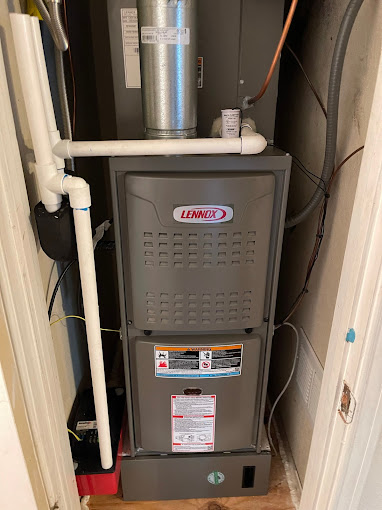
If your furnace has white PVC vent pipes, it is a high-efficiency model that produces water. A clogged drain line, trap, or condensate pump can trigger a float switch that keeps the furnace from starting. Look for water around the unit or a pump that is full. Attic furnaces also have a secondary pan, and a float switch there can shut the system down too.
Many furnaces have a small window with a blinking LED on the control board. Count the blinks and match the pattern to the chart on the inside of the panel door. Write it down. Even if you cannot fix it yourself, the code saves time when a technician arrives.
After these checks, turn the furnace off for about 30 seconds and back on to restart it. Try this once or twice, not repeatedly.
If the checklist does not get your heat back, the cause is usually one of these:
Working inside a gas furnace involves high voltage, gas, and combustion. For anything beyond the checklist above, a licensed HVAC technician is the safe choice.
A technician will confirm the thermostat is sending a signal, test power and the transformer, read the error code, and follow the startup sequence to see where it stops. The final price depends on the cause, the part, and your furnace model, so you should get a clear explanation and an upfront price before any work starts.
Why won't my furnace kick on when the thermostat is set to heat? The most common causes are a thermostat problem (dead batteries, wrong mode, or a setpoint below room temperature), a furnace power switch or breaker that is off, a loose furnace door panel, a clogged filter, or a full condensate drain on a high-efficiency furnace. If those all check out, the problem is usually a part inside the furnace such as the control board, a safety switch, or the inducer motor.
How do I know if the problem is the thermostat or the furnace? Set the thermostat to Heat and a few degrees above room temperature, then listen at the furnace. If nothing at all happens and the thermostat screen is blank, start with the thermostat batteries and power. If the thermostat looks normal but the furnace never responds, check the furnace switch, breaker, and door panel. If the furnace starts but stops partway, the furnace itself is the likely source.
Why does my furnace blower run but no heat comes out? If the blower runs but the air stays cold, the burners are not lighting or are shutting off early. Check that the thermostat fan is set to Auto rather than On, then look for a blinking error code. Ignition problems such as a worn igniter or dirty flame sensor are common causes.
Is it safe to keep resetting my furnace? Turning the furnace off for about 30 seconds and back on once or twice is fine. If it keeps failing or locking out, stop. Repeated resets can hide a real safety problem, and a technician should find the cause.
Boost Air And Plumbing is licensed, bonded and insured, with upfront pricing and same-day appointments when available. We serve Arlington, Grand Prairie, Mansfield, Dallas, Fort Worth, and the surrounding North Texas communities. Call (817) 527-8883 or book online. Our hours are Monday through Saturday, 8am to 7pm, with after-hours and Sunday emergency appointments available. Learn more about our furnace repair service.
Call (817) 527-8883 or book online. We serve Arlington, Grand Prairie, and the surrounding North Texas communities.
Visit our shops
Boost Air And Plumbing dispatches trucks from our Arlington main office and our Grand Prairie shop, covering Tarrant and Dallas counties with same-day HVAC and plumbing service. Call (817) 527-8883 for either location.
Arlington (Main Office)
Grand Prairie