
Arlington (Main Office)
Boost Air And PlumbingArlington, TX
- 2313 Michigan Ct
Arlington, TX 76016 - (817) 612-9107
- Monday to Saturday: 8:00 AM to 7:00 PM
Boost Air Blog
Replacing a furnace in Grapevine? Call (817) 612-9107 or Book Online
Part of our Furnace Installation and Replacement guide.
Quick answer
Replacing a furnace in Grapevine starts with a load calculation, then the fuel, the venting, and the ducts the new furnace has to use. The old unit's size is a clue, not the answer. The estimate is free, and it should be in writing before installation day.
A replacement furnace has to heat this house, connect to the ducts that are there or that have to be fixed, and vent in a way the closet or the attic can support. Grapevine makes that concrete. Houses near Main Street and College Street often still have a small closet or a low attic and a metal flue that has been in place for decades. Houses built later, toward Grapevine Lake and toward Colleyville, are more often two stories with a long attic duct run. Copying a neighbor's furnace, or the number on the old rating plate, skips the step that decides the job.
This is about forced-air furnaces. Replacement estimates are free. Financing is available as low as $99 a month on approved credit. Furnace installation is the service. HVAC service in Grapevine is the local page.
A furnace that is too large heats in a short blast and shuts off. Rooms feel uneven, and the heat exchanger sees more starts. A furnace that is too small runs and never catches the thermostat on a night in the 20s, which Grapevine still gets a few times each winter. Both mistakes start when someone multiplies square feet by a number they remembered.
A load calculation, the method in ACCA Manual J, uses the house: insulation, windows and which way they face, leakage, ceiling height, and a room over a garage. An older house near the historic streets and a later two-story toward the lake can share a square footage and still need different furnaces.
The BTU number on the old furnace is a biased clue. Many furnaces from the 1990s and 2000s were copied from the last house in the tract. Ask to see the calculation. A furnace a size or two smaller than the one coming out can be the right result.
The ducts decide whether that heat can leave the cabinet. Crushed flex, a kinked filter slot, or one hall return with the bedroom doors shut will make a new furnace behave like the old one. If the upstairs never matched the downstairs, say so before the equipment is ordered. The fix is often a return or a duct repair. A bigger furnace rarely solves it.
AFUE, annual fuel utilization efficiency, is the share of the fuel that becomes heat in a lab test. An 80 percent furnace sends about a fifth of the fuel heat out the flue. A furnace at 90 percent or above is a condensing furnace. It pulls more heat from the exhaust, the exhaust cools, and water forms. That difference decides the pipes, not the slogan on the door.
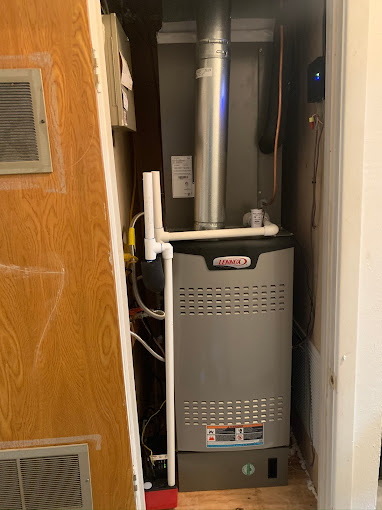
An 80 percent furnace uses a metal flue and does not need its own condensate drain. It fits a lot of older Grapevine closets that already have a metal flue and no nearby drain. A condensing furnace needs plastic intake and exhaust, sloped back to the furnace, and a drain that will not freeze on a hard night or back up into the cabinet. If the attic has no workable drain, or the only wall for the pipe is a long run with no slope, the higher number is not available yet. The estimate should name the vent work, or it should specify the 80 percent furnace the existing flue can serve.
Ask which furnace the house can vent. The gas bill also moves with the winter, the thermostat, and the ducts.
A house that already has gas should see a gas furnace quote first. The line and a vent path are there, and a sound air conditioner can stay. The fuel does not have to change because the furnace failed.
An electric furnace makes heat from electricity. It belongs in the conversation when the house has no gas. It draws a heavy circuit, so a full panel, or a circuit sized for a smaller unit, belongs on the written estimate. On a cold week it also costs more to run than gas in a house that already has a meter.
A heat pump moves heat. On the 40s and 50s that make up most of a Grapevine winter, it can heat with less electricity than strips. On a night in the 20s it needs backup: electric strips, or a gas furnace in a dual-fuel pair. That pair fits when the outdoor unit and the furnace are both due. It is extra equipment when only the furnace failed and the air conditioner is fine.
If you want both options, the estimate should show the gas furnace beside the heat pump, with the duct and panel work written on each.
Look through the attic or the closet before a furnace is ordered. Crushed, disconnected, or waterlogged flex will not carry the new airflow. Many older Grapevine houses have one hall return. It works when doors are undercut and left open, and it starves the furnace when every bedroom door is shut.
The metal flue on an 80 percent furnace has to be the right size, clear, and supported. A condensing furnace leaves that flue for PVC. If a gas water heater shares the metal flue, removing the furnace can leave the water heater on a chimney that is now too large. The exhaust can cool and spill. The estimate should say what happens to that water heater: a liner, a new vent, or a different heater. Found during the free estimate, it is a choice. Found on installation morning, it is a different job.
Closets in the original part of town are often small. The new cabinet has to fit, and the openings have to give the furnace the combustion air it requires. Measure the closet. The 2004 furnace's depth is not a promise.
Texas cities generally require a permit and an inspection when a furnace is replaced. Plan on that in Grapevine. The inspector looks at the gas connection, the vent, the electrical disconnect, and the condensate on a condensing furnace. The written estimate should say the permit is pulled when the city requires it, and who meets the inspector. A shared flue or a panel change that needs its own permit belongs in that same conversation, before you approve the work.
Work is scheduled Monday through Saturday, 8am to 7pm. A straight swap, with ducts and venting already suitable, is often one visit. Someone needs to be there for the walk-through.
Floors on the path get covered. Gas and power come off, the old furnace comes out, and the new one is set level. The plenum is sealed, the gas line is leak-checked, and the vent is finished in metal or plastic. A condensing furnace gets a trapped drain. A filter goes in with the arrow the right way. Startup is watched from the inducer to the flame to the blower, and temperature rise is compared with the rating plate. Outside that range, the job is still open.
The walk-through covers the filter size, the shutoff, the switch, and the thermostat. A shared flue, an undersized gas line, or a coil that has to move, if it was outside the estimate, waits until you have seen it.
When you book, know whether the house has gas, where the furnace sits, which room stays cold, whether the water heater is beside it, and whether the air conditioner is staying.
Call (817) 612-9107 or book online for a free replacement estimate. Financing is available as low as $99 a month on approved credit. Approve the number from that visit, after someone has seen the furnace, the ducts, and the vent.
Call (817) 612-9107 or book online. We serve Arlington, Grand Prairie, and the surrounding North Texas communities.
Visit our shops
Boost Air And Plumbing dispatches trucks from our Arlington main office and our Grand Prairie shop, covering Tarrant and Dallas counties with same-day HVAC and plumbing service. Call (817) 612-9107 for either location.
Arlington (Main Office)
Grand Prairie