
Arlington (Main Office)
Boost Air And PlumbingArlington, TX
- 2313 Michigan Ct
Arlington, TX 76016 - (817) 612-9107
- Monday to Saturday: 8:00 AM to 7:00 PM
Boost Air Blog
Furnace Keeps Tripping the Breaker? Call (817) 612-9107 or Book Online
Part of our Furnace Repair guide.
Quick answer
A furnace that keeps tripping the breaker in Grand Prairie loses power because the circuit is overloaded, shorted, or wet. Reset it once only if you do not smell burning and the cabinet is dry. A second trip stays off. Do not open the control panel with the power on, and do not replace the breaker with a larger one. If you smell gas, leave and call the gas utility or 911 from outside.
A furnace that keeps tripping the breaker dies differently from a furnace that shuts itself off. The breaker handle goes to the middle, or all the way off. The cabinet goes silent. The thermostat may still say Heat, because many screens run on batteries after the furnace loses power. Nothing in the furnace will run until that breaker stays on.
A limit, a flame sensor, or a pressure switch can stop the burners while the breaker never moves. That pattern is a furnace that keeps shutting off in Grand Prairie. This page is the breaker. Furnace repair sorts a short, a motor, and a bad circuit. HVAC service in Grand Prairie is the local page. The shop is at 2100 TX-360 Ste 907. A tripped breaker in the garage and a silent attic furnace are one circuit.
Do not keep resetting a breaker that trips again. Each reset lets the fault draw another surge. If you smell burning, hot insulation, scorched plastic, or hot metal, leave the breaker off and call. Do not open the furnace control panel with the power on. That compartment has line voltage, a capacitor that can hold a charge after the breaker is off, and a wheel that spins. Do not take the cover off the breaker panel. Do not stand in water and flip the breaker. If you smell gas, a rotten egg odor, leave the home and call the gas utility or 911 from outside. Do not use a phone inside.
A breaker opens to protect the wire. It trips on too much current, on current leaking to ground, or because the breaker itself is weak and can no longer hold its number. Those feel the same in the hallway. When it trips is what sorts them.
Watch one call for heat, and only if you do not smell burning and the floor is dry.
If the breaker opened, leave it off. A second try is how a warm wire becomes a burned wire.
If the blower runs, the air stays cold, and the breaker stays on, use furnace blowing cold air in Grand Prairie. A trip kills the fan too. The thermostat says heat and the house stays cold is the checklist for a furnace that still has power.
See what else died. Garage lights, a freezer, or an attic outlet that went out with the furnace share the breaker. Unplug the extra load. A space heater on that circuit trips on cold nights because the heater and the blower pull current together. One reset is the test. If it still opens with nothing else running, the furnace is the load. Leave it off.
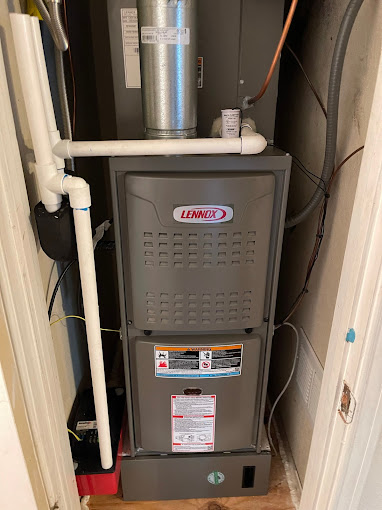
Read the rating plate on the outside of the cabinet. It lists the maximum breaker and the minimum circuit. If the panel breaker is smaller than that maximum, say so when you call. Do not change it. A larger breaker does not repair a motor. It lets the wire heat inside the wall.
Change a packed filter only with the breaker off, using the size on the cabinet. A dirty filter usually opens the high limit and leaves the breaker closed. A weak motor still runs hotter when it cannot move air, so change the filter. If the next cycle trips, the filter was not a short.
Look under the furnace. A high-efficiency furnace makes water, and a clogged condensate line, a cracked trap, or a pan that was never piped puts that water in the cabinet. Water on a motor or a board can trip the breaker and can shock you. A wet cabinet, or scorch on the furnace switch, means the breaker stays off.
A gas furnace here is usually one 120-volt breaker. Heat strips are usually two handles tied together. Do not reset one handle of a pair by itself, and do not borrow a breaker from another slot.
The blower motor is the part that most often takes the breaker out. A shorted winding or a seized bearing pulls far more current than the circuit allows. A dust-packed wheel, or a wheel rubbing the housing, stalls the motor the same way.
The capacitor is the part people get hurt on. A failed run capacitor leaves the motor humming, locked, and drawing high current until the breaker opens. The capacitor holds a charge with the breaker off. Do not open the door to discharge it, and do not match a new one by the shape of the can.
A cracked ignitor usually fails open. The furnace will not light, and the breaker stays on. A shorted ignitor is less common. It can trip the breaker, or blow the fuse on the board, when the ignitor should glow. The inducer, the draft motor that starts first, trips the breaker at the beginning of the call if it is shorted or its wire has rubbed bare. An inducer that simply will not spin usually leaves the breaker on and the furnace waiting on the pressure switch. Do not take the burner cover off to look at either part.
A rodent, a loose connector, or a wire worn through on a sharp edge arcs to the cabinet. You might see a brown mark at the furnace switch, or only the trip. Condensate in the blower compartment, or rain down a vent, puts line voltage and water on the same metal. Do not dry a board with the breaker on.
A breaker can be the failed part. They wear out. A weak one trips below its printed number on a furnace that ran for years on that circuit. The replacement has to match the wire and the rating plate. A bigger number stops the symptom and heats the wire where you cannot see it.
The furnace should be on its own circuit, sized from that plate. A bigger breaker swapped in to get through the night does not fix a shared circuit or a short.
If the thermostat still says Heat and the furnace is silent, look at the breaker before you replace the thermostat. A display that dies with the trip and returns on reset was a furnace with no power. A warm or scorched breaker can be a loose connection in the panel. Leave that cover on.
Call after the second trip, or on the first if you smelled burning, the cabinet is wet, or the breaker opens as the blower or the inducer starts. The wrong part, bought before a test, leaves the short in place.
You should hear what failed, and the price, before parts go in. A capacitor, a motor, a wire, or a matching breaker, with a sound heat exchanger, is a repair. A seized motor plus a cracked heat exchanger, or a major failure around 15 years old, is a time to hear a replacement price beside the repair. The U.S. Department of Energy's Energy Saver material lists that age as one reason to consider replacement. The exchanger and the circuit decide it. Ask for a free replacement estimate if the numbers are close. Financing as low as $99 a month is available on qualifying replacements. That figure is financing. The equipment price is in the written quote.
Do not hold the breaker on, feed the furnace with an extension cord, or pull wires in an open control panel.
The service fee is $0 when you approve the repair. Same-day service is available Monday through Friday. Hours are Monday through Saturday, 8am to 7pm. Call (817) 612-9107 or book online. Say when the breaker trips, whether you smell burning, and whether the cabinet is wet.
Call (817) 612-9107 or book online. We serve Arlington, Grand Prairie, and the surrounding North Texas communities.
Visit our shops
Boost Air And Plumbing dispatches trucks from our Arlington main office and our Grand Prairie shop, covering Tarrant and Dallas counties with same-day HVAC and plumbing service. Call (817) 612-9107 for either location.
Arlington (Main Office)
Grand Prairie