
Arlington (Main Office)
Boost Air And PlumbingArlington, TX
- 2313 Michigan Ct
Arlington, TX 76016 - (817) 612-9107
- Monday to Saturday: 8:00 AM to 7:00 PM
Boost Air Blog
Furnace Pressure Switch Stuck Open? Call (817) 612-9107 or Book Online
Part of our Furnace Repair guide.
Quick answer
A furnace pressure switch stuck open in Grapevine means the switch never closed, so the furnace will not prove draft and will not light. Check the chart on the door for the blink code, and from the ground look for a nest, leaves, or ice on the intake and exhaust. Do not jumper the switch. A hose, a clogged trap, a blocked vent, a weak inducer, or the switch itself can cause it. If you smell gas, leave and call the gas utility or 911 from outside.
Do not jumper, tape, or replace the pressure switch with a wire. That tells the furnace that exhaust is leaving when it may not be, and the exhaust can include carbon monoxide, which has no smell. If you smell gas, leave and call the gas utility or 911 from outside. Do not use a phone inside. If a carbon monoxide alarm sounds, or anyone has a headache, nausea, or dizziness that eases outdoors, get everyone out and call 911. Do not tape the door switch.
Furnace pressure switch stuck open is the Grapevine call where a motor starts, the burners never light, and the furnace tries again or locks out. The thermostat still says Heat. The contacts did not close, so the board never got proof of draft. The switch can be bad. More often the draft never arrived.
Furnace repair is the visit that measures that draft instead of swapping the switch first. HVAC service in Grapevine is the local page. There is no Grapevine shop. Trucks come from Arlington at 2313 Michigan Ct and from Grand Prairie at 2100 TX-360 Ste 907. Older closets near Main Street often still have a metal flue. Later houses toward Grapevine Lake are more often attic furnaces with PVC. The switch does the same job on both.
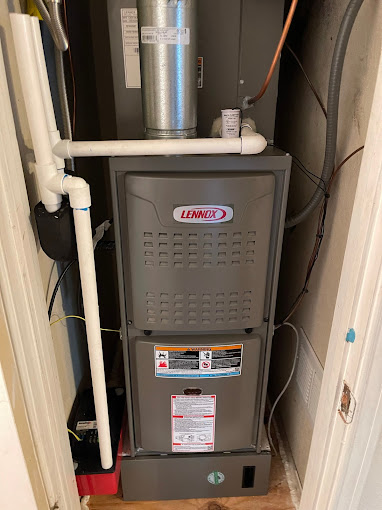
On a call for heat the board starts the inducer before the ignitor gets power. That draft motor pulls exhaust out, and a small hose carries the pressure to the switch. When the draft is strong enough, the switch closes. Only then does the board power the ignitor and open the gas valve. The flame sensor has to prove flame, and the blower starts after a delay.
If the switch stays open, the gas valve should stay closed, so this fault by itself should not smell like gas. A gas smell means leave. Some furnaces have a second switch for another stage or another port. The door chart says which one failed. They are not interchangeable.
Burners that light and then stay off are a furnace that keeps shutting off in Grand Prairie. A few minutes of heat, over and over, is furnace short cycling in Arlington. A silent cabinet is the thermostat says heat and the house stays cold. If the outdoor unit starts on a call for heat, this is a heat pump and it does not use this switch.
The status light blinks when the switch does not close. There is no blink count that means the same thing on every furnace. Do not take a code from a different model and force it onto this one. Read the light through the sight glass, or unlatch the blower door, count the blinks, and match them to the chart on that door. Write down any long pause, then latch the door. Do not remove the burner cover, and do not tape the door switch.
After you have looked at the vents, turn the furnace switch off for about 30 seconds and back on, once. If the same code returns, stop.
The hose gets brittle. One that has fallen off, cracked, kinked, or plugged leaks the pressure away, so the inducer can spin and the switch still stays open. With the power off, look only long enough to see that it is on both ports, then latch the door. Seating a hose that simply slipped off is a fair one-cycle test. Tape will not seal a crack. If it falls off again, or the code returns, stop. Do not blow or suck on the hose. That is how water gets into the switch.
Water in the hose is common on a condensing furnace. A sag, or a run that climbs toward the switch, holds a water plug, so the diaphragm inside the switch never moves. Do not shake that water into the switch. On a high-efficiency furnace the condensate trap is part of the pressure the switch reads, so sludge in the trap keeps it open and the cabinet may be wet besides. Furnace leaking water when the heat is on is that puddle. Drying the floor does not close the switch.
A dirty filter is the wrong first suspect. It is on the circulating air, and the switch watches the vent. A packed filter usually opens the high limit after the burners light. If they never light, look at the pipes and the trap.
The inducer cannot prove draft if the intake or the exhaust is blocked. On a condensing furnace those are usually PVC pipes on an outside wall. Leaves, seed fluff, a nest, a cover left on after summer, ice, or a screen set back in the pipe will close the end. A blocked cap or a metal flue that came apart in the attic does it on an older furnace. Exhaust spilling into an attic means leave the furnace off.
From the ground, clear debris at the mouth of a pipe you can reach without a ladder. Do not push it down the pipe, and do not climb the roof. If the blockage is inside the pipe or in the attic, stop. One reset after the opening is clear is the test. The same code means the problem is farther in.
The inducer fails on its own. A motor that hums and does not spin, a grind, or a wheel caked with rust will not build pressure. You hear the attempt, then silence, and no flame. Write down whether it ran. Do not stick a tool in the wheel or take the burner cover off to spin it. A shorted inducer can trip the breaker instead. A furnace that keeps tripping the breaker is that pattern. A second trip stays off.
The switch itself fails when the diaphragm tears, the contacts pit, or a port clogs. The pressure rating is printed on it, and the replacement has to match that furnace. The wrong switch can close too easily or never close. Do not jumper the old one to test a theory. Check the hose, the vent, and the trap before you buy the part.
A paper clip or a wire across the switch tells the board that draft is proven. The gas valve can then open while the flue is blocked, disconnected, or iced shut, and exhaust spills at the draft hood or into the attic. Carbon monoxide is in that exhaust. You cannot smell it. A headache, nausea, or dizziness that eases outdoors means get everyone out, even if no alarm has sounded. A rollout switch is not a stand-in for the pressure switch, and a bypass is not safe overnight.
Do not leave a jumper in until a part arrives, and do not tape the contacts shut. If an alarm is already sounding, get out and call 911 from outside. The longer steps are in a carbon monoxide alarm with the heat on.
Call if the same code returns after one reset, the inducer grinds or will not spin, the hose or cabinet is wet, you cannot see the pipes without a ladder, or anyone wants to bypass the switch. Have the blink pattern and whether the inducer ran.
You should hear what failed, and the price, before parts go in. A hose, a cleaned trap, a matched switch, or an inducer, with a sound heat exchanger and an open vent, is a repair. A cracked heat exchanger, or a vent that has been spilling exhaust, is not fixed by a new switch. On a furnace more than 15 years old, hear a replacement price beside a major repair. The U.S. Department of Energy's Energy Saver material lists that age as one reason to consider replacement, not as an expiration date. Ask for a free replacement estimate if the numbers are close. Financing as low as $99 a month is available on qualifying replacements. That figure is financing. The equipment price is in the written quote.
The service fee is $0 when you approve the repair. Same-day service is available Monday through Friday. Hours are Monday through Saturday, 8am to 7pm. Call (817) 612-9107 or book online.
Call (817) 612-9107 or book online. We serve Arlington, Grand Prairie, and the surrounding North Texas communities.
Visit our shops
Boost Air And Plumbing dispatches trucks from our Arlington main office and our Grand Prairie shop, covering Tarrant and Dallas counties with same-day HVAC and plumbing service. Call (817) 612-9107 for either location.
Arlington (Main Office)
Grand Prairie