
Arlington (Main Office)
Boost Air And PlumbingArlington, TX
- 2313 Michigan Ct
Arlington, TX 76016 - (817) 612-9107
- Monday to Saturday: 8:00 AM to 7:00 PM
Boost Air Blog
Furnace Leaking Water When the Heat Is On? Call (817) 612-9107 or Book Online
Part of our Furnace Repair guide.
Quick answer
Furnace leaking water when heat is on in Arlington is usually condensate that should have gone down a trap and a PVC drain. A clog, a cracked or loose pipe, a dead condensate pump, or a frozen drain does it. A humidifier or a shared coil pan can too. Water from a metal flue, or from inside the heat exchanger, is a reason to leave the furnace off. If the floor is wet, do not stand in it and flip a switch.
If you smell gas, a rotten egg odor, leave and call the gas utility or 911 from outside. Do not flip switches or use a phone inside. If a carbon monoxide alarm sounds, or anyone has a headache, nausea, or dizziness that eases outdoors, get everyone out and call 911. If the floor is wet, do not stand in it and flip the furnace switch or the breaker. Water on the board or the blower can shock you. Do not open the control panel, and leave the burner cover on.
Furnace leaking water when heat is on shows up in Arlington as a puddle in the closet, a stain on the ceiling under the attic, or drips off the cabinet once the thermostat calls for heat. On a high-efficiency furnace that water is often condensate that missed the drain. It can also be a humidifier, a pan from the air conditioner, or, on an older furnace, water coming back down the metal flue.
Furnace repair is the visit that finds which path the water took. HVAC service in Arlington is the local page. The Arlington shop is at 2313 Michigan Ct. The furnace is usually in a hall closet or the attic.
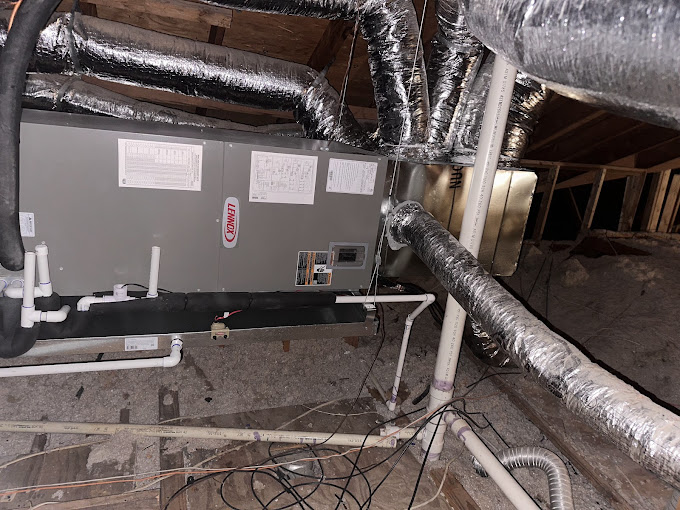
A furnace around 90 percent efficient or higher cools the exhaust in a secondary heat exchanger until water vapor turns to liquid. That water is slightly acidic. It should stay in a trap and a PVC line to a floor drain, a standpipe, or a pump. Water on the floor, in the blower compartment, or at a loose joint is not part of that design.
An 80 percent furnace is not built to condense. Hot exhaust should stay vapor in the metal flue until it is outside. White PVC on an outside wall means the condensing type. A metal flue means the older type. An attic leak often stains a ceiling first. Shut the furnace off if the ceiling is wet.
Sludge plugs the trap or the horizontal PVC. Water then comes out a loose joint, the collector box, or the cabinet. Many furnaces have a float in that line. When the float rises, the burners stop and the thermostat still says Heat. A float that sticks down, or a furnace with no float, gives you a puddle instead of a shutdown.
A clogged trap can also leave the pressure switch open, because on a condensing furnace the trap is part of the vent path that switch measures. The furnace may not light even after the floor looks dry. That fault is a pressure switch that stays open.
With the furnace off, look along the PVC without opening the burner box. Straighten a kink. Clear debris only where the line empties into the floor drain. Push a slipped fitting back together so it stops pouring, and still plan on a cemented joint. A sag that holds a belly of water will leak again. Do not pour bleach or drain cleaner into the trap. Do not take the trap apart if you are not sure it goes back the same way. If water returns on the next heat cycle, stop.
When the drain is uphill, a pump should empty a small reservoir through a tube. A dead pump, a stuck float, a kinked tube, or no power leaves it full, and a failed overflow float lets it spill. Full and silent means stop. Do not reach into a wired reservoir, and do not bypass the float.
A hard freeze can ice a drain in a cold attic or at an outside wall and back water into the furnace. Ice on the PVC exhaust can stop the furnace with no puddle. Do not pour boiling water on the pipe or use a torch, a heat gun, or a space heater. If you can see the ice from the ground, leave the furnace off until it thaws.
A bypass or fan-powered humidifier runs with the heat, so the leak shows up on a cold night and not in July. A stuck valve, a cracked pad frame, or a clogged humidifier drain is the usual source. Turn off the small valve on the humidifier line, not a house main, if the handle moves. Leave a seized handle alone. If one heat cycle stops the drip, leave the humidifier off. Do not take the furnace apart to pull the pad.
The cooling coil often sits on the same cabinet, with its own pan. It is not making new condensate while the heat runs, because the outdoor unit is off. A rusted pan or water left from summer can still drip when the blower starts. If the outdoor unit is running and the pan overflows, that is water indoors from an air conditioner. If the outdoor unit is what starts on a call for heat, this is a heat pump, not this gas-furnace drain.
A float that opened leaves the thermostat on Heat and the burners off. Once the cabinet is dry, use the thermostat says heat and the house stays cold. Warm air for a few minutes, over and over, is furnace short cycling in Arlington, more often a filter, a limit, or a flame sensor than a puddle.
Water at the draft hood, or dripping down the metal flue, means exhaust from an 80 percent furnace cooled enough to condense. A flue that is too large, too long, disconnected, or sitting in a cold attic can do that. The water rusts the flue and can rust the heat exchanger. White scale at the draft hood means leave it off. Do not wrap the flue or cap it. Exhaust has to leave the house.
On a condensing furnace the secondary heat exchanger is supposed to send that water to the trap. A crack or a corrosion hole lets it into the blower compartment or the burner area instead. Condensate that sat in a clogged exchanger can eat the metal before the furnace looks old. Water from the heat exchanger after the drain, the pump, and the humidifier are dry is a shut-off. A crack is also a path for combustion products into the supply air. Do not remove the burner cover, and do not run the furnace to see if it dries.
A cracked heat exchanger, and whether the furnace is replaced, is the decision after an inspection. A loose drain joint is a repair. A cracked secondary is not a patch you put back in service. You should hear what failed, and the price, before parts go in. If the exchanger is cracked, or a major failure shows up on a furnace more than 15 years old, hear a replacement price beside the repair. The U.S. Department of Energy's Energy Saver material lists that age as one reason to consider replacement, not as an expiration date. Ask for a free replacement estimate if the numbers are close. Financing as low as $99 a month is available on qualifying replacements. That figure is financing. The equipment price is in the written quote.
A backed-up drain ends up on the board and the blower. Water there can kill the board or trip the breaker. A furnace that keeps tripping the breaker is that fault. Leave a tripped breaker off while the cabinet is wet. Do not open the panel to dry the board. A capacitor in there can hold a charge with the power off.
Call when the water comes back, the pump stays full, the ceiling under an attic furnace is wet, water is in the burner area or coming off a metal flue, or water is on the blower or the board. Write down whether the vent is PVC or metal, whether a humidifier is attached, and whether the burners are still lighting.
The service fee is $0 when you approve the repair. Same-day service is available Monday through Friday. Hours are Monday through Saturday, 8am to 7pm. Call (817) 612-9107 or book online.
Call (817) 612-9107 or book online. We serve Arlington, Grand Prairie, and the surrounding North Texas communities.
Visit our shops
Boost Air And Plumbing dispatches trucks from our Arlington main office and our Grand Prairie shop, covering Tarrant and Dallas counties with same-day HVAC and plumbing service. Call (817) 612-9107 for either location.
Arlington (Main Office)
Grand Prairie