
Arlington (Main Office)
Boost Air And PlumbingArlington, TX
- 2313 Michigan Ct
Arlington, TX 76016 - (817) 612-9107
- Monday to Saturday: 8:00 AM to 7:00 PM
Boost Air Blog
Furnace Fan Won't Turn Off? Call (817) 612-9107 or Book Online
Part of our Furnace Repair guide.
Quick answer
A furnace fan that won't turn off in Grapevine is often the thermostat fan left on ON, which runs the blower on purpose. Set it to AUTO. The blower should stop about a minute or two after the burners shut off. A fan that runs much longer can be a limit switch cooling an overheated heat exchanger, or a control board holding the fan on. Do not open the blower compartment. If you smell gas, leave and call the gas utility or 911 from outside.
Do not open the blower compartment to make the fan stop. The capacitor in that compartment can hold a charge after the power is off, and the wheel spins. Do not tape the door switch. If you smell gas, leave and call the gas utility or 911 from outside. Do not use a phone inside. If a carbon monoxide alarm sounds, or anyone has a headache, nausea, or dizziness that eases outdoors, get everyone out and call 911. If you smell hot insulation or see smoke, turn the furnace switch off.
Furnace fan won't turn off is the Grapevine call where the blower is still moving air long after the house has reached the setpoint, or all evening with the burners off. A minute or two after the burners stop is the furnace clearing heat from the exchanger. Hours, with the fan set to AUTO, is a setting, a safety switch, or a fan circuit that is still calling.
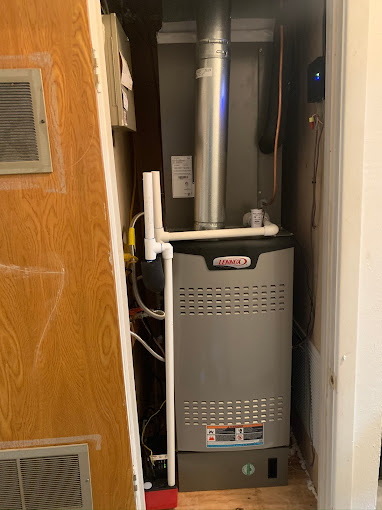
Furnace repair is the visit that finds which of those is still asking for the fan, before anyone condemns the motor. HVAC service in Grapevine is the local page. There is no Grapevine shop. Trucks come from Arlington at 2313 Michigan Ct and from Grand Prairie at 2100 TX-360 Ste 907. Older houses near Main Street, College Street, and Wall Street are often a closet furnace with a metal flue. Houses built later, between State Highway 26 and Grapevine Lake, are more often a two-story attic system with a long duct run. The fan does the same job in both. A closet furnace on those older streets is more likely to switch the blower from temperature. An attic furnace in the later houses usually times the blower from the control board.
The thermostat has a fan switch that is separate from Heat. AUTO runs the blower when the furnace asks for it, then stops it after the cooldown. ON runs the blower all the time, whether or not the burners are lit. Some thermostats also have a circulate setting between those two, which runs the fan for part of each hour on purpose. A fan left on ON, or on circulate, is the most common "it will not shut off" call, and it is not a failed motor. Set it to AUTO and wait.
The blower should stop about a minute or two after the burners shut off. On some furnaces the delay is a few minutes. It should not still be running for the rest of the hour. The last air at the vent can feel cool, because Grapevine attic ducts hold air that the burners are no longer heating. That short cool burst is the end of the cycle.
If the burners are still lit, the fan is supposed to run. Look at the setpoint. A number above the room temperature is a heat call, not a fan fault. A long cycle on a cold night can be normal. A thermostat that says Heat while the rooms stay cold is the thermostat says heat and the house stays cold. This page is the fan that continues after that call is finished.
Constant fan does not, by itself, burn extra gas. It can make the house feel cooler between cycles, and people then raise the heat. That higher setpoint is what adds gas use. The usage side of a bill that jumped is a furnace causing a high gas bill in Grand Prairie.
On a standard thermostat, unclip the display from the wall plate and leave the wires on their screws. If the blower stops after the normal delay, the thermostat was asking for the fan. Seat it back on the plate and check the fan setting. If the blower keeps running with the display off the plate, the call is in the cable or at the furnace. Do not pull individual wires off their letters, and do not jumper terminals. The wrong pair can blow the fuse on the board. If the thermostat is a communicating model on a single special cable, leave it on the wall.
On most gas furnaces, the high-limit switch opens when the heat exchanger is too hot. The gas valve closes. The blower is turned on, or kept on, to move that heat out. If the limit stays open, the fan can run a long time, the burners stay off, and the air goes from warm to room temperature. From the hallway that feels like a fan that will not stop.
A filter you cannot see light through, several closed supply vents, or a blower wheel packed with dust can cause that overheat. With the furnace switch off, replace the filter with the size printed on the cabinet. Open the supply vents. Latch the blower door. Turn the switch back on and try one cycle. If the burners light, die, and the fan keeps running, stop. Repeated limit trips are hard on the heat exchanger. Burners that start and stop every few minutes are furnace short cycling in Arlington.
The fan that keeps running after a limit trip is the furnace cooling itself. Do not press a rollout reset to force the burners to stay lit. Do not tape the door switch so the furnace will run with the door off.
The control board tells the blower when to start and when to stop. A board that sticks the fan relay on leaves the blower running with the thermostat satisfied and the fan set to AUTO. The test is at the board, after the thermostat wires and the limit switch are confirmed. Replacing the board because the fan acts odd, without that test, installs the wrong part. Do not open the compartment to watch the relay. A capacitor in there stores a charge with the breaker off.
The motor is often doing what a switch, a limit, or the board told it to do. A hum, a squeal, or air that is weak in every room at once is a different fault, and it still is not a parts swap from the hallway. The wider visit, including a blower that will not start at all, is a furnace blower that is off, or that never stops.
Older furnaces in the closets near Main Street may use a combination fan and limit control. One control turns the blower on from temperature and shuts the burners off if the exchanger gets too hot. If the fan contacts stick closed, the blower never stops. Do not turn that dial to force the fan off. The limit half of the same control is the overheat shutoff, and the wrong setting lets the exchanger run too hot.
If the outdoor unit starts on a call for heat, the house is on a heat pump, and this gas-furnace fan sequence does not apply. A system that will not hold the setpoint on a heat pump is heat pump not heating.
The visit confirms whether the thermostat is still calling for the fan, whether the limit switch is open, and whether the board is sending power to the motor with no call. The capacitor and the motor are tested when the fan is noisy, weak, or running without a call. The wheel is checked for a rub and for dust that would trip the limit again. If the burners are lighting, temperature rise is measured against the rating plate, so a weak blower is not left in place to overheat the exchanger. On an older fan and limit control, the contacts and the settings are checked against that plate.
You should hear what failed, and the price, before parts go in. The price depends on the furnace and the cause. A fan setting, a filter, a limit, or a relay, with a sound heat exchanger, is a repair. A seized motor plus a cracked heat exchanger, or a major failure on a furnace more than 15 years old, is a time to hear a replacement price beside the repair. The U.S. Department of Energy's Energy Saver material lists that age as one reason to consider replacement, not as an expiration date.
Call if the fan is on AUTO, the filter is new, and the blower is still running long after the burners have stopped. Also call if the burners keep dying while the fan runs, you smell electrical burning, or the breaker trips. A second trip stays off. Do not hold the breaker on. Do not open the blower door to unplug the motor. Do not bypass the limit so the fan can stop while the burners stay lit.
Boost Air And Plumbing repairs gas furnaces in Grapevine, Arlington, Grand Prairie, and nearby communities. We do not service boilers. The service fee is $0 when you approve the repair. Same-day service is available Monday through Friday. Hours are Monday through Saturday, 8am to 7pm. Call (817) 612-9107 or book online. Say whether the fan is set to AUTO or ON, whether the burners are still lighting, and about how long the blower runs after the flame goes out.
Call (817) 612-9107 or book online. We serve Arlington, Grand Prairie, and the surrounding North Texas communities.
Visit our shops
Boost Air And Plumbing dispatches trucks from our Arlington main office and our Grand Prairie shop, covering Tarrant and Dallas counties with same-day HVAC and plumbing service. Call (817) 612-9107 for either location.
Arlington (Main Office)
Grand Prairie